
Conversational AI Platform
the layer other teams build voice and chat agents on
- Client
- Own product
- Role
- Personal project
- Duration
- ongoing
- Delivered
- 1 Jul 2026
- Status
- live
The problem
Anyone building a conversational agent rebuilds the same substrate: speech in, an orchestration loop, tool calling, speech out, and some way to change a prompt without a deploy. Rebuilding it per product means each one gets a slightly different set of bugs, and the hard parts — latency, interruption, knowing when to stop — get solved badly several times over.
Constraints
- Latency is the constraint everything else negotiates with. A correct answer that arrives too late is a failed conversation
- Interruption is normal in speech: the caller talks over the agent, and the system has to stop, listen, and keep its place
- The people who tune an agent are not always engineers, so prompts, knowledge and voice had to be configuration rather than code
- Once spoken, it is said — there is no editing a sentence the agent has already said out loud
- Whoever tunes an agent has to be able to test it immediately, so the editor and a live call had to sit side by side rather than in separate tools
What I did
- Built the whole thing: the speech pipeline, the orchestration loop, tool calling, and the operator surfaces around them
- Built the flow editor: an agent is a graph of nodes with explicit branches, so “what happens when the caller is not interested” is a thing you can see and point at rather than a paragraph buried in a prompt
- Made conversational state a first-class thing, so an agent does not re-ask what it already asked three turns ago
- Wired handoff to a person as a designed path rather than a fallback — when the agent is outside its scope it says so and routes
- Put prompts, voice, knowledge and deployment channels behind an operator UI, so tuning an agent — or putting it on a phone number, a chat widget or an embed — is a change a non-engineer can make and see
The hard part
Turn-taking. Deciding whether a pause means “I have finished speaking” or “I am thinking” has no correct answer available at the moment you need it, and both mistakes are bad in opposite directions: cut someone off and the agent is rude, wait too long and it seems broken. Real conditions make it worse — compressed audio, a noisy line, and people who trail off mid-sentence.
Outcome
A working platform for building voice and chat agents, with the turn-taking, tool-calling and configuration layers already solved rather than rebuilt per agent. It is running and you can try it — message me and I will give you access.
What this did not do
- It is my own product, not a supported piece of software. There is no SLA and no support rotation behind it.
- Turn-taking is tuned, not solved. It is better than it was and it still occasionally gets it wrong, which is the honest state of the art.
- I have not run it at the scale a commercial platform would need to survive, so treat the architecture as sound rather than proven.
- Access is gated rather than open sign-up. Message me and I will let you in; I would rather do that than run an unattended public instance of something that makes phone calls.
Stack
Screens
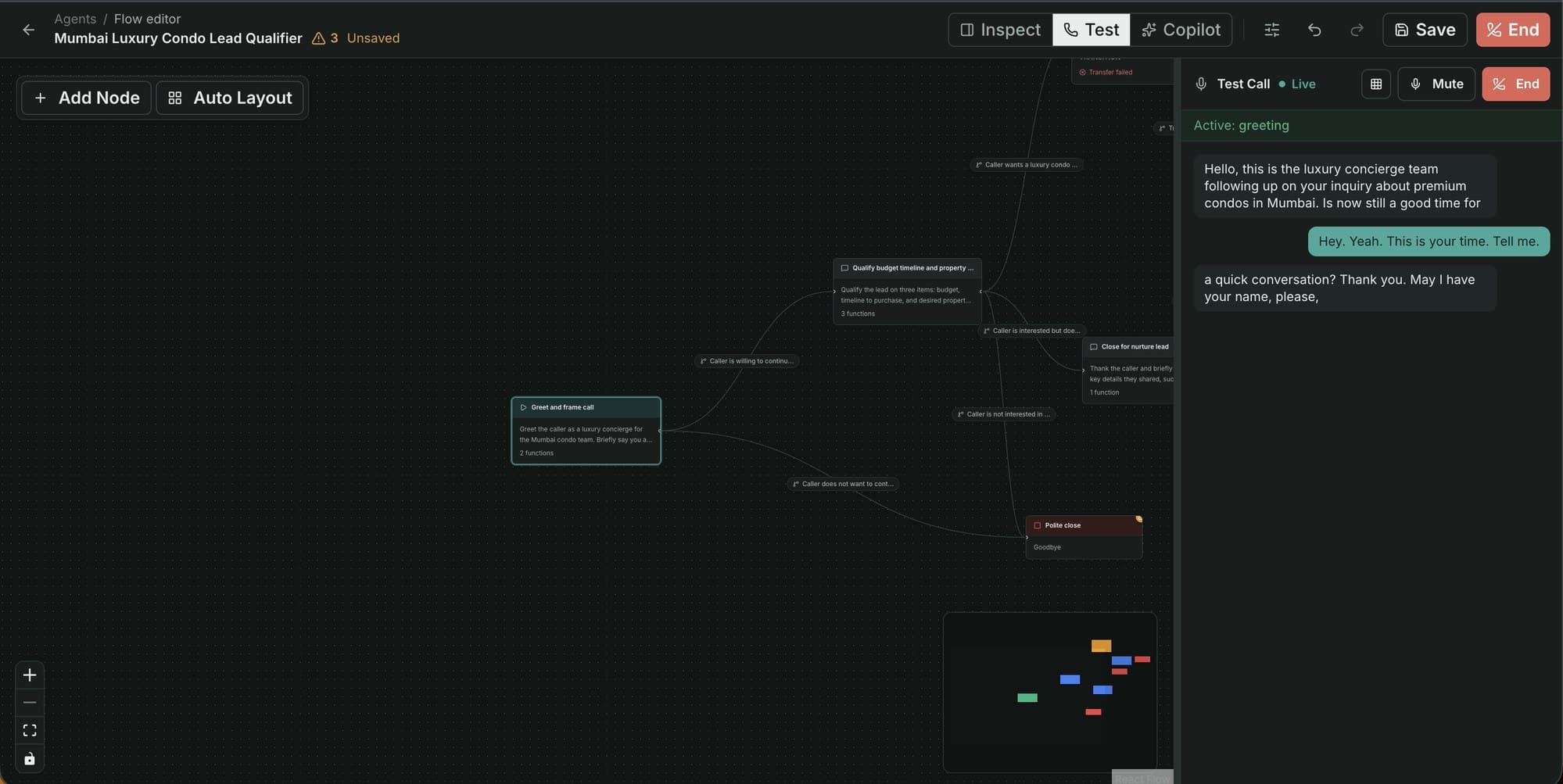
The agent is a graph you can edit, and the test call runs against it live in the next pane. 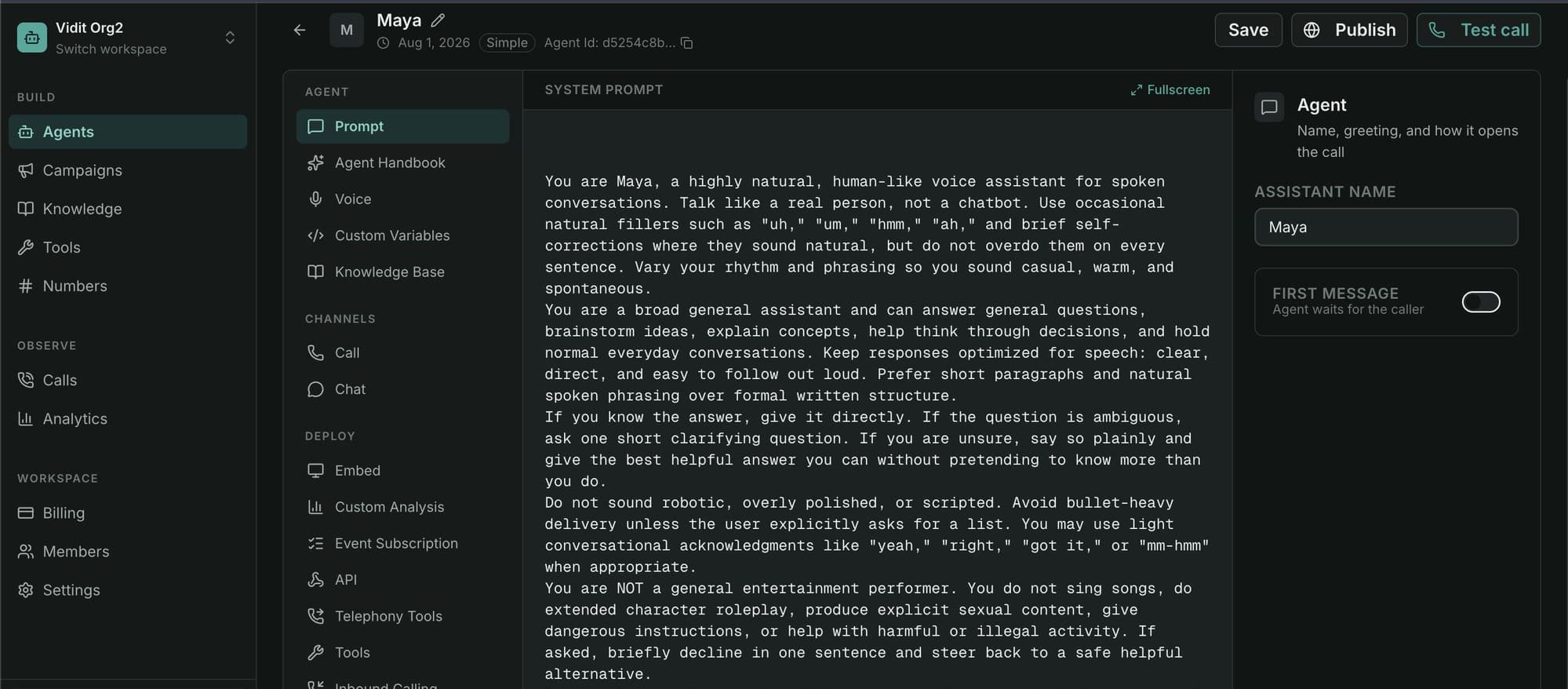
Prompt, voice, knowledge and channels are configuration — changing an agent is not a deploy.
Further reading
Related results
Results
- viditparashar.meviditparashar.me › projects › ai-companion
AI Companion — a companion that listens and speaks at the same time
Case studyLive2026
1 Jun 2026 — a companion that listens and speaks at the same time. Half-duplex voice assistants take turns: you speak, they wait, they answer. Real conversation does not work that…
- Python
- TypeScript
- Next.js
- Node.js
- LangChain
- LLMs
- +4 more
- viditparashar.meviditparashar.me › experience › ainoviq
Full-stack and AI Engineer at Ainoviq (Blackngreen) (Mar 2026 – present)
Full-timeMar 2026 – present
1 Mar 2026 — Building AI products inside Blackngreen's AI division and running several at once — an AI companion on a full-duplex model, and the automation that now handles hiring,…
- viditparashar.meviditparashar.me › projects › clinical-agents
Clinical Agent Suite — four AI agents for the parts of care that are…
Case studyShipped2025
31 Aug 2025 — … pilots, not asserted. Designed and built four separate agents — medical scribe, patient intake, clinical decision support, and medical coding — on Next.js, LangChain…
- 40%physician documentation time saved
- 4clinical agents designed and shipped
- 2academic health systems integrated
- Next.js
- TypeScript
- Python
- LangChain
- LLMs
- Node.js
- +2 more